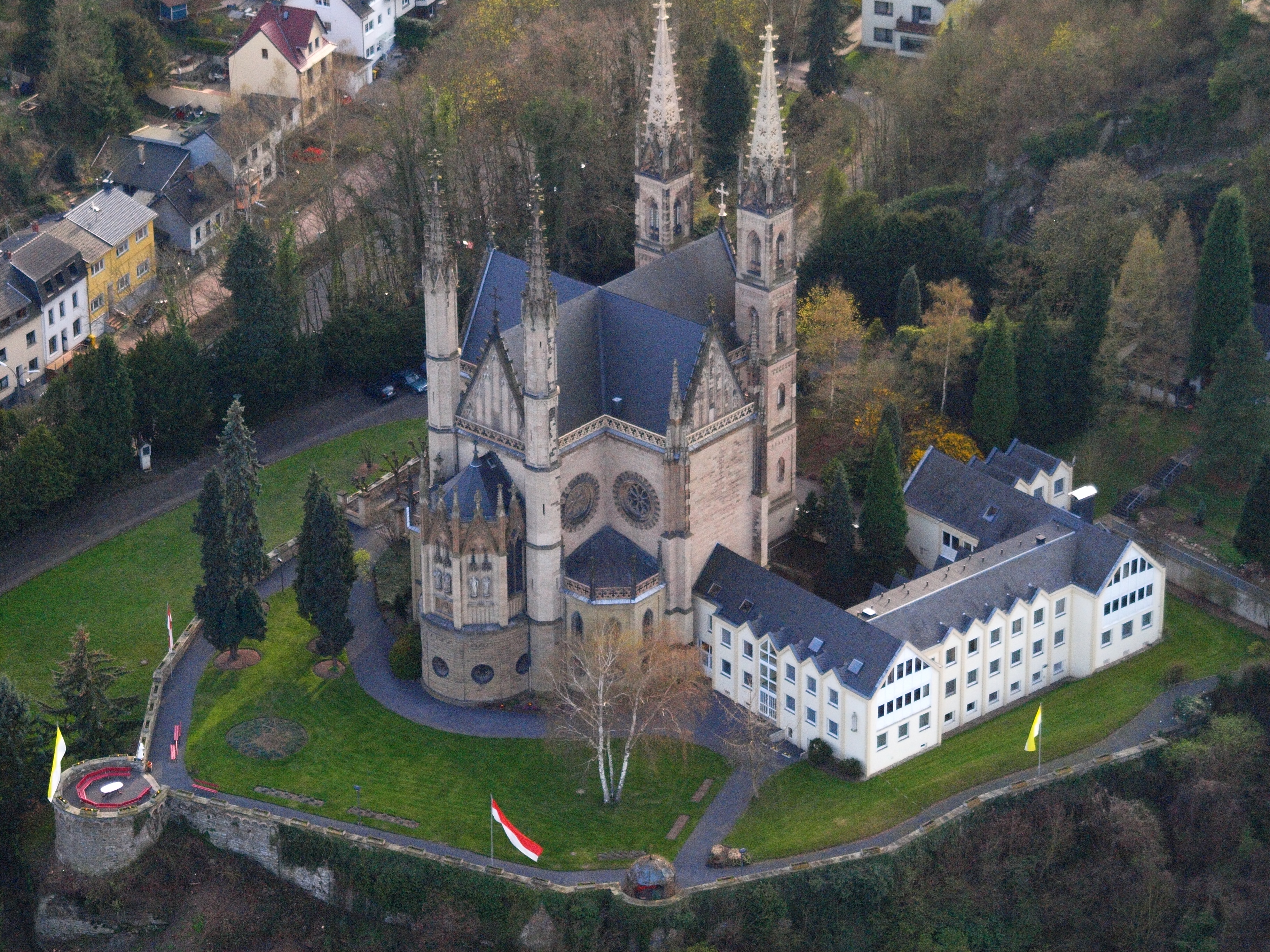
The Apollinaris Church is surrounded by monastery buildings and a beautiful garden with a wonderful view of the Rhine
Touring the Rhine on the Remagen side, I saw this monastery that looked to me like a castle sitting on the hill
As I drove through Remagen, following the curves of the Rhine, something on the hillside caught my eye. To my left stood a small fairytale castle, with towers and arches that seemed more suited to a storybook than an ordinary weekday drive.
Curiosity won immediately. I pulled over at the next opportunity, determined to find out what this mysterious “castle” really was.

As it turns out, the building wasn’t a castle at all. It was the Apollinaris Church, surrounded by former Franciscan monastery buildings and a peaceful garden that overlooks the Rhine in one of the most breathtaking panoramas you can imagine. The monastery itself was home to the Franciscan order until 2006 and is now used by another religious community — but the spirit of quiet devotion still lingers in the air.
St. Apollinaris received its current name at the beginning of the 15th century from the relics of St. Apollinaris. It is not known exactly how long they have been there, but most likely since the last decades of the 14th century.
A Church That Looks Like a Castle
The Apollinaris Church is one of those places where architecture and landscape seem to have conspired to create something magical. Its neo‑Gothic towers rise above the vineyards and treetops, giving it that castle‑like appearance that first caught my attention. Up close, the details are even more striking: pointed arches, delicate stonework, and a sense of verticality that draws your eyes upward.
The church was built in the 19th century on the site of an older chapel dedicated to St. Apollinaris, the patron saint of the region. Inside, the walls are adorned with stunning frescoes created by members of the Nazarene art movement — warm, expressive, and deeply spiritual.
There were pilgrimages to St. Apollinaris and to the 14th-century sarcophagus in the crypt, where the main relic is kept to this day.

St. Apollinaris Monastery 
St. Apollinaris church 
St. Apollinaris church St. Apollinaris church 
St. Apollinaris Monastery 
St. Apollinaris Monastery gruft 
St. Apollinaris Monastery, Maria and Jesus 
St. Apollinaris Monastery 
St. Apollinaris Monastery terrace 
St. Apollinaris Monastery terrace 
St. Apollinaris Monastery terrace and vineyards 

Apollinaris Monastery sign 
Honoring the Franciscan monks that stayed there until 2006 
St. Apollinaris church 
St. Apollinaris church 
St. Apollinaris church
A Garden With a View
What makes this place unforgettable, though, is the setting.
The church is surrounded by a garden that feels almost monastic in its calmness — quiet paths, old trees, and benches perfectly placed for contemplation. And then there’s the view: the Rhine stretching out below, winding its way between hills and vineyards, with barges gliding slowly along the water.
It’s the kind of view that makes you pause, breathe a little deeper, and feel grateful for the unexpected detours in life.
A Place of Peace Above the River
Even though the monastery buildings are no longer home to the Franciscans, the entire complex still radiates a sense of serenity. There’s something grounding about walking through a place where generations of monks once lived, prayed, and tended the land. You can almost feel the rhythm of their days lingering in the stones and pathways.
For visitors, the Apollinaris Church offers a moment of stillness — a chance to step away from the busy Rhine valley below and into a world shaped by faith, art, and nature.
The St. Apollinaris relic
Only assumptions can be made about the origin of the relic. They probably come from the Benedictine Abbey of Siegburg, which bequeathed one of its precious relics to its provost founded in 1117 on today’s Apollinarisberg. The Siegburg Benedictines looked after the old Apollinaris Church until 1793.
At the end of 2006, the Franciscan monks left Mount Apollinaris and the “Gemeinschaft der gekreuzigten und auferstandenen Liebe” (Community of the crucified and risen love”) and took over the pilgrimage. On the first pilgrimage day of the great Apollinaris pilgrimage in 2007, Bishop Dr. Reinhard Marx commissioned the new community on the mountain to restore the old traditions.

Tumba with the head relic of Apollinaris in the crypt of the Apollinaris Church in Remagen
According to legend, the relics on the Apollinaris came to Germany in 1164 together with those of the three kings by the Archbishop of Cologne, Reinald von Dassel. A small church was built on the Apollinarisberg near Remagen, which was looked after by Benedictines from the Siegburg Abbey
Pictured: St. Apollinaris relic by Joachim Schäfer – Ökumenisches Heiligenlexikon
A Worthwhile Stop Along the Rhine
If you ever find yourself driving through Remagen, don’t just admire the “castle on the hill” from afar. Take the time to drive up the winding road, explore the grounds, and soak in the view. Whether you’re drawn by architecture, history, or simply the beauty of the Rhine, the Apollinaris Church is a place that rewards curiosity.