In these so-called “Haushaltsschulen” from the past, young, middle-class women were taught household skills, like cooking, baking, sewing, handicrafts, gardening and cleaning to prepare them to be good housewives

In connection with the women’s movement, around 1900, the first textbooks for home economics were also developed. Initially, nevertheless, household training was not viewed as a profession, but rather as a preparation for marriage. But despite all reform efforts, it stayed that way: those who could afford it, still hired a housekeeper (“maid”).
Since attendance at a household school was often subject to a fee, it was mainly the middle class who could afford it for their daughters. Women from simpler backgrounds were “in jobs” until they got married, meaning they worked as maids in an upscale household or in a hotel, sanatorium, etc. in order to learn the relevant activities to earn a living. Home economics education was seen as part of women’s duty of care, but was not widely recognized by society.

An employed woman, for example, who worked as a housekeeper, laundress, seamstress, or cleaner, had responsibilities. She will not neglect her role as a housewife and mother in the family. These activities were originally tailored to the private household. From them, domestic professions developed with different functions. These include a housekeeper, a governess, a decision maker, or a home economics teacher.

In the Haushaltsschule were lesson plans as early as 1900! Chemical experiments that were carried out; Syrup was won and jam was made! There were large scientific pictures hanging on the walls everywhere.
They showed animals and plants that we use for our food. The former also taught us which parts were more or less nutritious, and which parts were unusable.

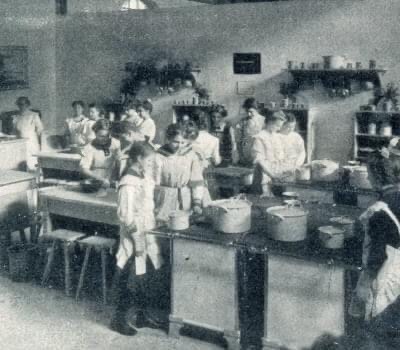
The students were taught about the different types of stoves, mostly a coal stove was used at the time. Whether modern or traditional, which was certainly also a question of the budget. There was a notice on the wall: “The girls should carefully grasp the briquettes with pliers to always keep their hands clean”
Something else was taught, which was basically multitasking. “Each dish has to be prepared, so that everything comes to the table at the same time.” Women also cooked on several other stove burners.

The inevitable, washing dishes and cleaning up was also part of the lessons, because dishwashers were not yet among the “modern” kitchen facilities” at that time:
Once everything has been cooked and scientifically explained, it is devoured with a healthy appetite. Then, it is time to wash and clean the whole kitchen. Washing the dishes by hand – that too has to be learned.

After dinner the recipe had to be entered in a “recipe booklet” and some math had to be done. The exact cost of the food items had to be drawn up for each dish.
It had to be on the penny. Entire households have suffered multiple times. The suffering was just because the housewife did not know how to get through the month by budgeting.
The Reifenstein School Concept
Per Wikipedia: Between 1880 and 1900, the Reifenstein schools concept was initiated by Ida von Kortzfleisch, a Prussian noble woman and early German feminist. Reifenstein refers to Reifenstein im Eichsfeld, a municipality in Thuringia and site of the first permanent school.
Below: Reifensteiner Schule Nieder-Ofleiden, the first class of 1898 in their Sunday dresses. By Wikimedia

The Reifensteiner Verband was comprised from 1897 till 1990 and owned about 15 schools and cooperated with further operators. About 40 “wirtschaftliche Frauenschulen” or Rural Economist Women schools were connected to the Reifensteiner concept and movement. It allowed higher education for women already in the German Kaiserreich.
Below: The Reifensteiner Schule Nieder-Ofleiden, the first class of 1898 in their Sunday dresses. By Wikimedia