My daughter and I enjoyed some beautiful, sunny days early October in the vicinity of Füssen near the King Ludwig II castles. Since Neuschwanstein was under renovation, we were looking forward to take a tour through Hohenschwangau castle, which was also Ludwig’s and Otto’s childhood home.
Nestled in the shadow of its famous neighbor Neuschwanstein, Hohenschwangau Castle quietly reigns with its own regal charm. Our visit to this Neo-Gothic beauty started on a winding path with a horse drawn buggy.
A Horse-Drawn Prelude
After buying our tour tickets we proceeded to take a horse buggy up a semi- steep hill, with the plan to hike back down after the tour.


Instead of walking the short uphill path, we opted for a horse-drawn carriage ride from the entrance below. The gentle rhythm of the horses, the crisp Alpine air, and the sound of birdsong made the ascent feel like a scene from a period film. As we curved through the forested road, the castle slowly emerged—its yellow façade glowing against the green hills.
Garden Views and Mountain Breezes
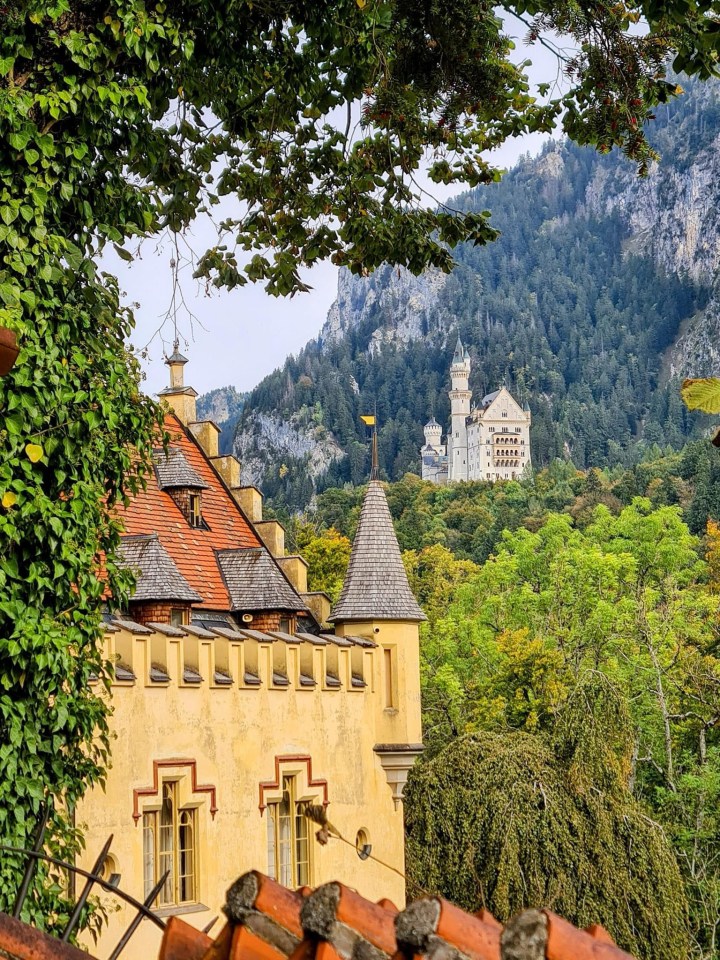
Before stepping inside, I wandered through the castle gardens, which offered sweeping views of the surrounding lakes and mountains. The manicured hedges, stone benches, and quiet corners felt like a royal retreat. From here, I could see the shimmering Alpsee below and even catch a glimpse of Neuschwanstein perched dramatically across the valley.


History:
A predecessor castle “Schwanstein” was first mentioned in a document in 1397. Over the centuries, the castle has been badly damaged. In 1832, Crown Prince Maximilian acquired the castle and had it converted into today’s castle. After his death, his son, King Ludwig II, took over the property and had it decorated according to his preferences. The castle is located directly opposite Neuschwanstein Castle, built for Ludwig II, in the Hohenschwangau district near Füssen. Unfortunately, taking pictures were not permitted inside.


Today’s Hohenschwangau Castle was built between 1537 and 1547. It was integrated into the partially preserved outer walls of Schwanstein Castle from the 14th century. The main building is a four-story complex. It was remodeled in 1833–1837 in neo-Gothic style. The façade is painted yellow. This building has three round towers with polygonal superstructures.

The castle served as a summer residence for the royal family. It was also the childhood home of the two sons, the future kings Ludwig II and Otto. Their mother, Marie of Bavaria (1825–1889), often went on mountain hikes with them. She took them to the old castles of Vorder- and Hinterhohenschwangau and Frauenstein. Mother Marie lived here every year after the death of King Max II in 1864 every year in the summer.
Below you see Ludwig and Otto with his parents


In their absence, Ludwig II frequently stayed at the castle during construction of his own Neuschwanstein Castle from 1869 to 1884. It officially bore the name Neue Burg Hohenschwangau until 1886.
Ludwig II did not change anything in Hohenschwangau except his own bedroom. In it, he had a group of rocks built in 1864. A waterfall flowed over these rocks. He also built an apparatus for creating an artificial rainbow. It featured a night sky with a moon and stars. These were illuminated by an intricate system of mirrors from the upper floor.
After Ludwig’s death in 1886, mother Queen Marie had the room restored to its original state. She died almost three years after the death of her son in 1889 at Hohenschwangau Castle.