There’s something deeply satisfying about crafting a dish that’s both humble and iconic. Leberkäse—often translated as “Bavarian meatloaf”—is a staple in German butcher shops and beer gardens, known for its smooth texture, savory flavor, and golden crust. This week, I decided to make it myself, and what a journey it was!
I have fond memories of eating Leberkäse, sometimes called Fleischkäse, which I could happily have for breakfast. The name “Leberkäse” can be deceptive, as it contains neither liver nor cheese; instead, it is mainly made from pork. Consequently, some people call it Fleischkäse, and in English-speaking countries, it’s commonly referred to as “German meatloaf.”

Pork shoulder 
Boiling pork 
Process pork with spices in a Food processor (IMO Ninja is the best) 
Add the spices 
Add crushed ice 
Smooth Leberkäse batter 
shape a pattern on top of Leberkaese batter 
Bake the Leberkaese 
Store in refrigerator or freeze 
If prefered slice the Leberkäse in a pan 
Leberkäse on German roll
🧂 The Ingredients: Honest and Hearty
Leberkäse is all about quality and balance. I started with lean pork, veal, pork back fat, and ice—yes, ice! It’s essential for emulsifying the meat and keeping the texture silky. The seasoning was classic: salt, white pepper, marjoram, ginger and a hint of nutmeg. No liver, despite the name—just pure, finely blended meat.
Emulsifier and Stabilizer, per 2.2 lb (1 kg) of meat:
• 400 g. crushed ice – keeps the emulsion cool and moist (is a must!)
• 2 tablespoons nonfat dry milk powder – adds protein and improves binding (optional)
• 1 teaspoon baking powder (with phosphates) – helps stabilize the emulsion (optional)
• 1 teaspoon mustard flour (optional) – enhances binding and flavor (optional)
🥶 The Technique: Chill and Blend
Temperature control is everything. I chilled all my ingredients and tools to keep the fat from separating. First, I ground the pork with skin and the onion. Then I blended the lean meat and Prague Powder #1 curing salt and with half the ice snow until it formed a smooth, pale paste. After chilling, I added the pork fat and remaining ice, blending until the mixture in my Ninja mixer was creamy and uniform.
Finally, I folded in the ground pork and Majoram or Thyme —just enough to distribute everything evenly without over mixing.

In my opinion, the Ninja blender works best for grinding meat. I recently purchased this Ninja Kitchen System with Food Processor on Amazon, and it has exceeded my expectations.
Curing salt, specifically Prague Powder #1, is not absolutely essential for the recipe; it primarily serves to maintain the pink or red color during baking. You can buy Prague Powder #1 here on Amazon. Without it, the meat will turn gray when cooked. Instead, you can simply use more Kosher salt to enhance the flavor. As an optional tip: if you want to preserve that appealing red hue in the meat, you could add a couple of drops of beet juice to give it a more authentic appearance.
🧈 The Bake: Golden and Glorious
I lined a loaf pan, smoothed the mixture in, and scored the top with a diamond pattern. Into the oven it went at 180°C (356°F), baking until the top turned a rich golden brown (70 to 90 min.) and the aroma filled my kitchen. The crust puffed slightly, forming that signature dome that makes Leberkäse so irresistible.
🍽️ The Serving: Bavarian Simplicity
I sliced it thick and served it warm with sweet mustard and a crusty Semmel (roll). It’s also perfect cold, thinly sliced for sandwiches, or pan-fried for a crispy edge. No matter how you serve it, Leberkäse delivers comfort in every bite.
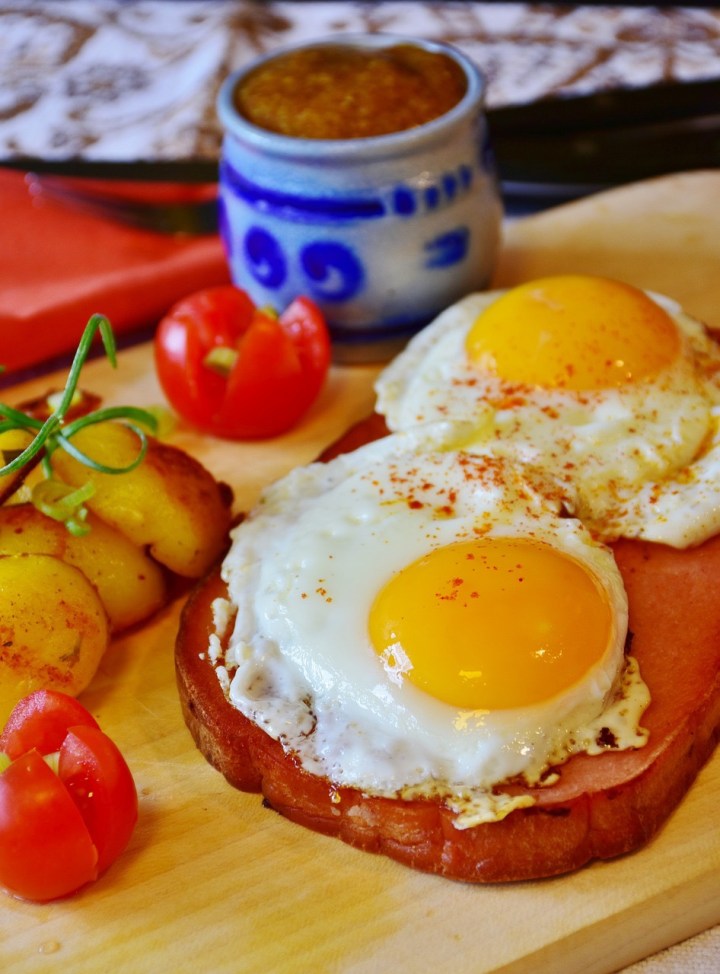
Apart from Bratwurst and Weisswurst, Leberkäse is undoubtedly one of the most favored snacks in Bavaria. It is typically served warm in a bread roll or as a main dish accompanied by a fried egg and either home fries or potato salad.
💬 Final Thoughts: A Butcher’s Classic, Made at Home
Making Leberkäse from scratch was a labor of love. It’s not just a recipe—it’s a tradition, a technique, and a taste of Bavarian heritage. The texture was smooth, the flavor deep and satisfying, and the process surprisingly meditative.
Next time, I might try mini portions or experiment with cheese-filled versions. But for now, I’m proud to say: my kitchen smells like a Metzgerei, and my heart feels full.
The recipe below is written in English and German
Leberkäse, a Bavarian comfort food

Ingredients
- 1 1/3 pound lean pork (mageres Schweinefleisch)
- 1 pound pork belly (fetter Schweinebauch)
- 1/4 pound bacon, uncured/unsalted (Speck, unbehandelt und ungesalzen).
- 1/2 tsp Curing Salt or Prague Powder #1 on Amazon below (see directions on package).
- 1 tsp. Baking powder (with phosphate) as emulsifier, binding agent
- 1 tsp salt (Salz).
- 1 tsp white pepper (weisser Pfeffer).
- 1 onion cut in cubes gehackte Zwiebel).
- 1 tsp Majoran or Thyme
- 1/2 tsp Nutmeg (Muskatnuss)
- 1/2 tsp Ginger, (Ingwer) or Coriander
- 400 g crushed ice (Eisschnee)


To keep the redness in the Leberkäse you can order Prague Powder #1 Curing salt
As a binding agent, I recommend a small amount of Baking powder with phosphate
Instructions
- Freeze cubed meat in the freezer for about about 30 minutes Fleisch in Würfel schneiden und anfrieren für 30 minuten)
- Crush ice to make Ice snow. (Die Eiswürfel in der Küchenmaschine/Blender zu Eisschnee verarbeiten).
- Keep the ice snow in the refrigerator until needed (Eisschnee bis zum Gebrauch im Gefrierfach aufbewahren).
- Mix quickly the spices and onion with the cooled meat (das gut gekühlte Fleisch schnell mit den Gewürzen und Zwiebel mischen).
- The mixture has to stay cold, so work fast (es ist wichtig dass es kalt bleibt, sonst lässt es sich nicht fein genug mischen).
- Mince the meat in the mixer, in 2 portion, at highest speed for 1 minute. (das Fleisch in die Maschine geben, in 2 Portionen damit es schneller mixt, auf höchster Stufe für 1 Minute mixen).
- Add the ice snow to the mixture, and mix again at the highest speed (den Eisschnee zugeben und nochmal schnell auf hoher Stufe durchmischen).
- Spray a cooled loaf cake pan with cooking spray, or lay out with parchment paper and fill with the mixture. (eine gut gekühlte Kastenform ausfetten, die Masse in die Form geben).
- Press down on the mixture so the air bubbles can escape, make a diamond shape pattern in the dough with a wet spatula (don’t cut). (einige male stauchen damit keine Luftblasen im Teig sind, mit einem feuchten Teigschaber Rauten in die Masse drücken).
- Bake at 350 F for 70 to 90 minute (bei ca. 180 C, 70 bis 90 min backen).
- If the Leberkaese is still pale, put it under the broiler for several minutes (wenn der Leberkäse noch etwas blass ist kurz den Broiler anmachen).
- Internal temperature needs to reach 170 F or 76 C
Notes
Serve on a Kaiser roll with mustard, or with potato salad as a side