
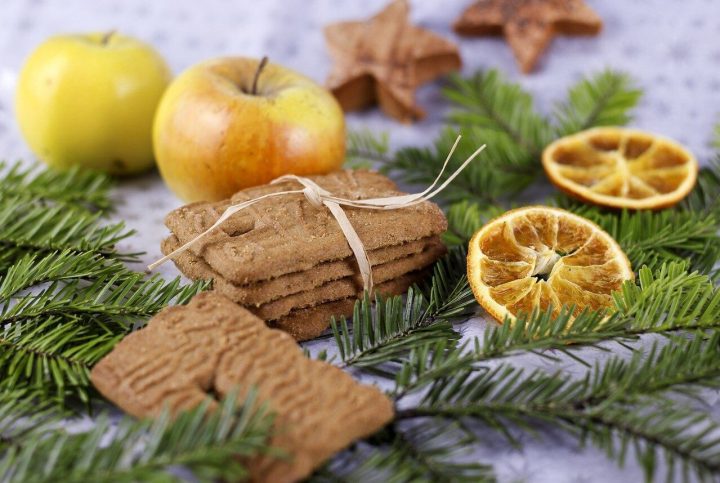
Spekulatius are thin and crispy spice cookies that most people probably know because of their beautiful shape
The typical German spice cookies are made with cinnamon, cloves and cardamom, that also gives the cookie not only taste but also a wonderfully dark brown color
There’s something magical about the scent of cinnamon, cloves, and cardamom wafting through the house in the days leading up to Christmas. For me, that magic was always wrapped up in one beloved tradition: baking German Spekulatius cookies with my mother and sisters.
Spekulatius, or Speculoos in English, is a thin crispy spice cookie made of seasoned shortcrust pastry in the form of figurative representations. The origin of the pastry is believed to have originated in Belgium and the Netherlands; but other regions such as the Lower Rhine or Westphalia also make some claims. In Dutch it is called Speculaas, in French as Spéculoos.
These spiced, intricately molded cookies weren’t just a treat—we as a family baked them together, laughing, chatting, and dusting flour across the kitchen like snow. It was our way of welcoming the season, one batch at a time.
The Ritual Begins: Mixing Memories
We’d gather around the kitchen table, each of us with a task. My mother would soften the butter and mix it with sugar and vanilla extract until it was creamy and fragrant. One by one, we’d crack eggs into the bowl, watching them disappear into the golden mixture.

Mix brown (or white) sugar and vanilla extract in large bowl 
Add the butter to the sugar 
Mix until well combined 
Add to 2 large beaten eggs to the flour mixture 
Beat egg, sugar and butter mixture till smooth 
Sift in the flour 
Add baking powder, salt, cinnamon, cloves and cardamon to the flour mixture 
Mix flour mixture until well combined 
Press dough together in a ball and wrap with plastic wrap. Place in the refrigerator 
Remove dough from refrigerator after 2 hrs. Place on pastry mat 
Roll out dough and use Spekulatius mold or cookie cutters 
Spekulatius rolling pin 
Spekulatius baking molds 
Dutch Spekulatius cookies 
German Spekulatius Spice Cookies
Then came the flour—sifted with care—and the spices that made Spekulatius so unmistakably festive: baking powder, salt, cinnamon, cloves, and cardamom. The aroma alone could transport us to a German Christmas market.
Kneading, Chilling, and Rolling with Joy
Once the dough came together, we’d knead it by hand on a pastry sheet, giggling as it stuck to our fingers. Wrapped in plastic, the dough would rest in the fridge for an hour or two, giving us time to prepare our molds or dig out our favorite Christmas-themed rolling pins.
Some years we used traditional Spekulatius molds—wooden carvings that turned dough into tiny works of art. We’d oil and flour each mold, press in egg-shaped pieces of dough, and trim the excess with a knife or twine. Releasing the cookies was always a delicate dance, but the results were worth it. Other years, we’d roll the dough thin and cut out stars, trees, and hearts. No matter the shape, the cookies carried the same warmth and spice.
The relief shape can be easily obtained by wooden molds, or silicon baking molds with corresponding patterned shapes, or a molding roll. With such a Spekulatius roller you only have to roll out the dough. Of course you can also simply cut out the cookies and eat them without elaborate reliefs.
A variety Embossed wooden Rolling Pin for baking Christmas cookies can be bought here on Amazon
Into the Oven, Into Our Hearts
We’d line the cookies on baking sheets and slide them into the oven, preheated to 350°F. In just 10 to 12 minutes, they’d turn golden at the edges, filling the house with a scent that meant Christmas was near.
Once cooled, we’d pile them into tins—some to share, some to savor with tea or cocoa, and some to sneak when no one was looking.
A Tradition That Lives On
Though we’re older now and scattered across different places, the memory of baking Spekulatius together remains one of my most cherished. Every time I make them, I feel my mother’s steady hands, hear my sisters’ laughter, and remember the joy of creating something beautiful together.
If you’ve never tried Spekulatius, I hope this inspires you to start your own tradition. And if you have, I’d love to hear your story.
The History of the Mold and Stamping Technique
The stamping technique may be derived from the molds used in some Christian traditions to mark sacramental bread, and the earliest molds featured religious motifs, including scenes from Bible stories and Christian symbols. Later, in the 17th and 18th century, heraldic themes of knights and fashionably dressed ladies became popular.

In addition to Spice Speculatius, there is the Almond Spekulatius, which is somewhat more subtly seasoned and is coated with sliced almonds on the underside before baking. Just place sliced almonds on the cookie sheet and the cookies on top, then bake.
Spekulatius, a spicy Christmas Cookie

Ingredients
- 1 1/4 cups brown sugar
- 1 tsp vanilla extract
- 1 1/8 cup butter (room-temperature)
- 2 medium eggs (room-temperature)
- 4 cups all-purpose flour
- 1/2 tsp baking powder
- 1/4 teaspoon salt
- 1 tbsp cinnamon
- 1 tsp ground cloves
- 1/2 teaspoon ground cardamom


A Christmas inspired rolling pin can be found here on Amazon
Instructions
- In a large bowl mix the sugar and vanilla extract with soft butter until well combined.
- Beat in eggs, add one at a time.
- Sift the flour in to the bowl.
- Add the baking powder, salt, cinnamon, cloves, and cardamom.
- Place mixture on pastry sheet and knead by hand until it forms to a stiff dough.
- Refrigerate for 1 to 2 hrs wrapped in plastic wrap.
- Preheat oven to 350 F
- You can now roll out the dough with your Christmas themed rolling pin, or follow steps below if using a mold.
- Preparing mold, shaping the Cookies:
- Oil and flour a Spekulatius mold and tap out all excess flour.
- Roll a golf ball-size piece of dough between your lightly floured hands into an egg shape.
- Press the dough into the mold, filling all crevices.
- Use a sharp knife or piece of kitchen twine to cut off excess dough, so the dough is flush with mold.
- Tap the mold on the counter to release the cookie dough, or use a sharp knife to start the release of dough.
- Carefully place the cookie on a cookie sheet and repeat with the rest of the dough.
- If this process becomes too burdensome, or you do not own an Spekulatius cookie mold, roll the dough 1/8 inch thick and cut out cookies using your favorite cookie cutters.
- Bake in an oven heated to 350 F for 10 to 12 minutes, or until cookies brown slightly around the edges.
Notes
These cookies can be decorated like conventional sugar cookies, but the old-fashioned mold imprints should not be overshadowed, nor should the delicate flavor of the dough be masked.
Store the cooled cookies tightly covered in a tin or plastic container. They should keep for several weeks, if not month.







Thank you,interested to try it